A Humble Pivot for Physical Artificial Intelligence
By Markus Wulfmeier, Chief Scientist
In our pursuit of general-purpose physical AI, our field keeps looking to the horizon: designing massive simulations, scraping internet video, curating ever-larger teleoperation datasets. Yet robotics is already quietly producing its own analogue of internet-scale data: deployment data from real systems doing real work in production.
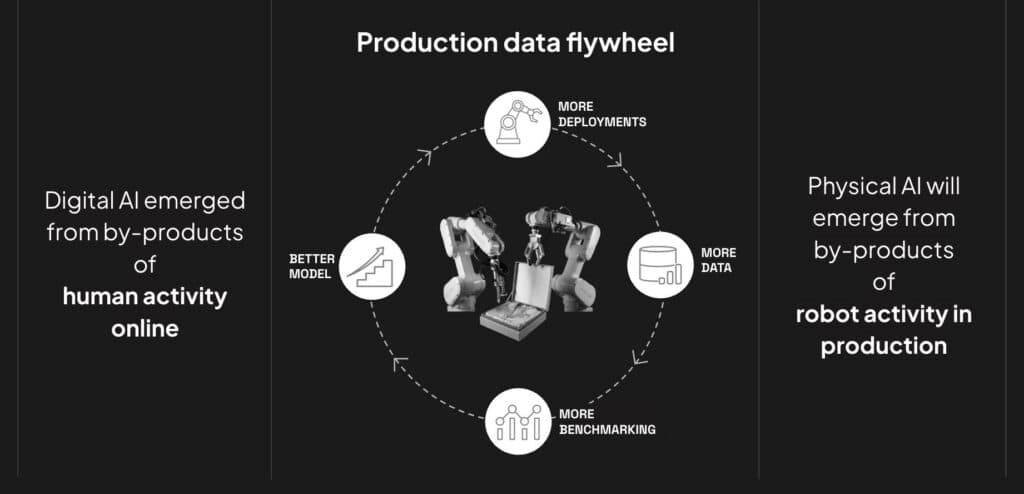
The most relevant “internet data” of robotics is the by-product of machines doing useful work in the physical world, just as the internet itself is the by-product of people doing (occasionally) useful work in the digital one. It is being generated right now, mostly discarded, and waiting to be used. This data, together with the existing modular control stacks that generate it, is robotics’ decisive advantage over other modalities. It bootstraps what we call mastery-first physical AI.
Mastery before generality
The dominant bet in physical AI today is generality-first: the hard part is training a sufficiently large, general model on video, simulation, and teleoperation, that eventually becomes good enough at everything. We are placing the opposite bet. Mastery is the most important challenge in physical AI today. This means we need to go deep on real tasks, in real deployments, until the system handles the long tail that only appears in production and expand outward from there to neighbouring tasks, configurations, and robot embodiments. We hold this view with conviction but without dogma. Generalist models are genuinely capable, improving quickly, and we build on them directly. Our claim is narrower and, we believe, more defensible: the last and decisive stretch of reliability, from impressive demo to autonomous operation at 99.9%+, is won in deployment, not in pretraining. Autonomy is gated by the long tail, and the long tail only reveals itself in production. Robotics’ “ChatGPT moment” won’t arrive because of any single breakthrough model. It will arrive via deployment — real customers with real goals — and that’s the harder problem in robotics.
Grounding in deployment
Physical AI is, at its core, a knowledge transfer problem. Solving every edge scenario in advance is impossible, so the question becomes where to start from. Here, proximity is vital. Much as mathematical pretraining sets better conditions for quantitative tasks, the information most critical for generalization and adaptation in production stems directly from deployment environments. Like the human-generated web for digital AI, this internet of robotics is a starting point, rather than a final destination for our models. Finally, deployment grounds not only the data but the benchmarks. Because rigorous evaluation drives performance, measuring what production actually demands mitigates Goodhart’s law and the pull of proxy metrics.
The classical stack as harness
Grounding the training pipeline in deployment builds the foundation for creating useful physical AI at scale. On their own, today’s open, closed, or in-house models sit well below the success rates production demands. The existing modular stack forms a harness around the model: it catches failures, keeps the overall system above the autonomy threshold, and enables safe evaluation while the model is still improving. At the same time, our models already exceed the classical stack along some axes, such that the combined system — classical harness plus VLA — leads to a superior system. This lets us put models into real operations from day one, with paying customers, rather than in separate pilots.
The harness changes how we think about readiness – it bootstraps our models and our iteration cycles. Models can be cheaply expanded and patched via small numbers of successful demonstrations, imperfect classical-stack trajectories, or targeted simulation. Large-scale reinforcement learning, as decisive as it is for physical mastery, can finally be focused on exactly the problems that matter, inside a safe and robust deployment workflow. And rather than optimizing any single site, the objective becomes the velocity and efficiency of scaling: how cheaply experience transfers to the next plant, configuration, or robot embodiment. The classical stack does more than harness the model: it bootstraps the foundation model itself.
Warehouse before living room
Consequently, we believe physical AI will mature in warehouses and factories long before the living room. The data already exists, deployment makes evaluation and iteration possible, and targeted feedback patches models across the last and hardest stretch to extreme reliability. Simulation and teleoperation are not going away, but their role shifts from primary data sources to tools that complement and accelerate learning grounded in deployment.
It is also why this is not a path for a brand-new startup. The first real proof of physical AI being ready will not come from a novel application built from scratch, but from an existing company using its deployed, autonomous systems to bootstrap the next generation of models.
Caption: The real world follows an extreme long-tail distribution. Solving robotics means solving that tail, one edge case at a time. Because these cases cannot be predicted in advance, any solution has to live inside deployment. Our “Library of Chaos”, millions of real-world edge cases together with a continuous feedback stream from robots in production, becomes the foundation for mastery-first physical AI.
Early evidence
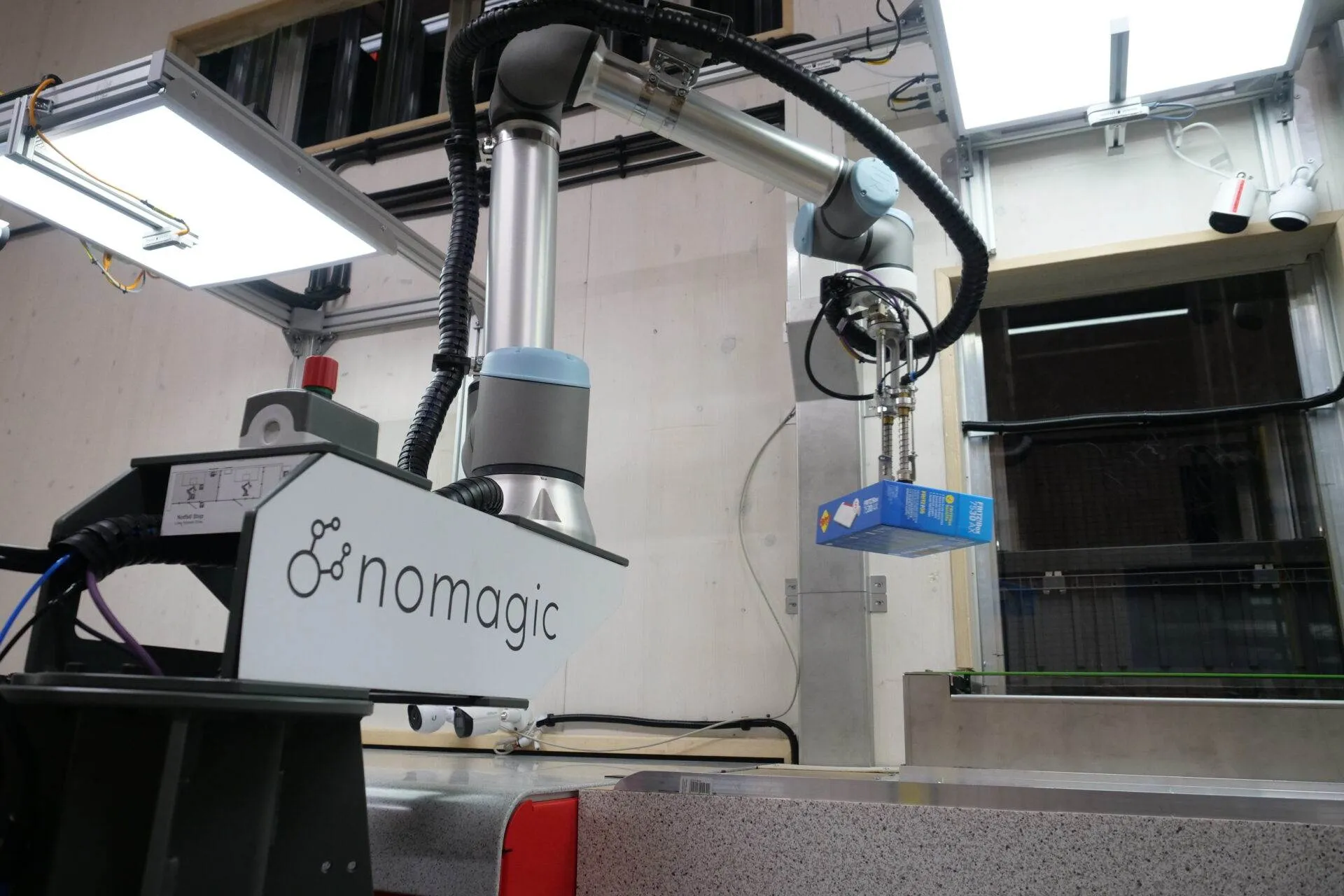
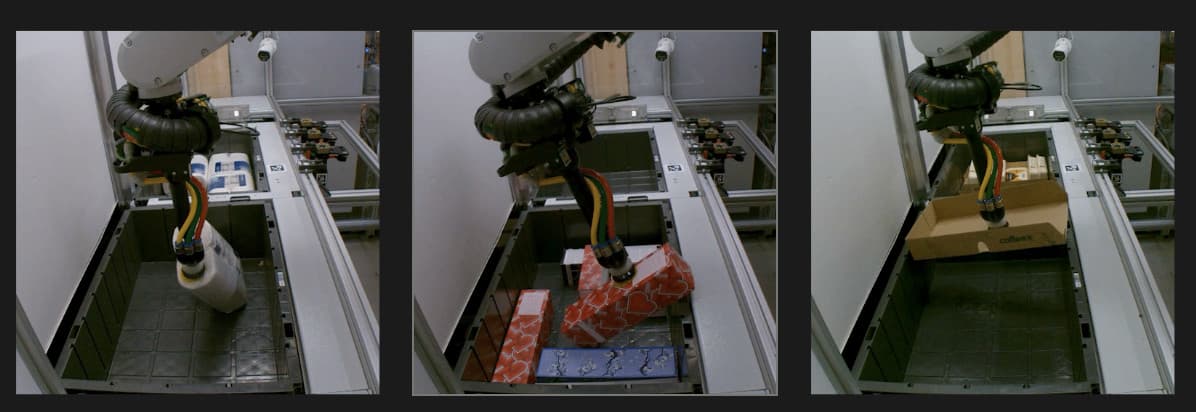
We are already seeing early support for our thesis. We have deployed what we believe is the world’s first item-manipulation VLA in production, resolving targeted edge cases in live operation at a paying customer rather than a separate pilot. And the same flywheel will be used to adapt across tools, including our shoebox gripper — a first, direct test of how effectively experience transfers from one configuration to the next.
The pattern extends beyond action to perception. Deployment-based iteration has carried our visual understanding systems past operating points that state-of-the-art generalist models could not reach under identical production conditions. This is the difference between an impressive demo and a system that clears the bar where autonomy and ROI begin. We will soon share a detailed post on how this enables mastery in targeted understanding of the physical world.
What comes next
There is much to learn about artificial learning integrated into deployment: how little targeted data is needed to adapt a production-based policy, which representations transfer best across sites and embodiments, and how success predictors can let systems identify and fix their own failures. We are committed to sharing more as this research progresses, and we look forward to fostering new collaborations.
We are looking for world-class researchers and engineers to join us. If you are excited about scaling mastery for physical AI, in actual deployment rather than prototypes, we want to hear from you!
By Filip Grządkowski, VP Engineering In the race to automate the physical world, not all intelligence is created equal. For years, robotics has been driven by breakthroughs in AI labs:…
Reliability, not hardware or AI models, is becoming the true competitive moat in Physical AI. As robots move from demos to real‑world use, only systems that reach 99.9% reliability will…
The award highlights leaders and innovators who have significantly contributed to the development of Poland's digital ecosystem and technological landscape.


.svg)