The Last Few Percent: Getting Visual Order Verification Production-Ready
By Michał Grzejdziak-Zdziarski, Senior Machine Learning Manager; Markus Wulfmeier, Chief Scientist
Making sure every order that ships to a customer is correct sounds like a solved problem until you look at what actually happens on a warehouse floor. Depending on the process, roughly 1% of orders still go out with errors: generating extra costs, operational complexity and customer dissatisfaction. Today, catching those errors mostly comes down to weight-based checks, but scales aren’t a perfect solution: they struggle with light items and require perfect master data about weight of each item. This is where visual AI-based order verification can have real impact. The task is easy to state – before an order ships, confirm that there is the correct quantity of items in the order – but the input is not. Items arrive packed tightly into cardboard, often with only fragments visible to the camera, and the system has to verify them anyway.
Spot, our order verification system, recently passed the final acceptance test for this task in pharmaceutical intralogistics and is now going into deployment at scale, verifying 150k orders daily, reaching a detected error rate above 98% at a false alert rate below 0.8%. Below is what made that hard, and what it took to get there.
What the two numbers mean
The job is a detection problem with two error types that trade off against each other, and both carry a direct operational cost.
Detected error rate is recall over faulty orders — of all the orders that genuinely contain a mistake, the share Spot flags. “Mistake” here means a counting error: a missing item or an extra item. At 98%+, fewer than 2 in 100 real errors slip through.
False alert rate is the false-positive rate – how often a correct order gets flagged as wrong. Every false alert pulls an operator off the line to inspect a box that was fine, so this number maps directly to labor cost. Below 0.8% means Spot is effectively silent on good orders.
The tension between them is the whole difficulty. Lowering the decision threshold to catch more real errors also raises more false alarms; tightening it to suppress false alarms lets real errors through. Most systems can hit one of these targets. Sitting at a good operating point on both at once -high recall and a sub-1% false-positive rate, on production data – is the part that doesn’t come for free.
Why the vision problem is genuinely hard
Every item in the box raises one main question: how many are there? In the pharmaceutical fulfillment we work with, incorrect quantities account for over 95% of the order errors that still slip through.
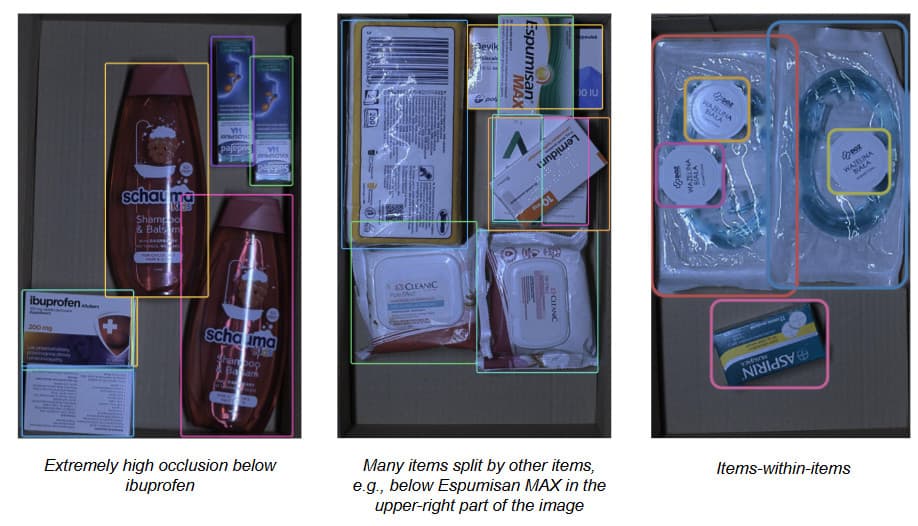
Counting is an instance-separation problem: the model has to resolve how many distinct objects are present, overcoming following challenges:
Severe occlusion. Sometimes only a few millimeters of an item are visible. The signal per instance shrinks to almost nothing, and the model has to decide whether a sliver of packaging is a separate item or part of one already counted.
Split items. One product is visually cut into two regions by another sitting in front of it, breaking the usual assumption that an instance is a single connected region so naive counting double-counts it.
Side-on stacking. Items are piled so only the side faces of the boxes show, removing the top-face views that carry most of the counting signal. There’s no clean top-down angle to fall back on.
Item-on-item. A small item sits directly on top of a larger one, with no gap between them. The model has to separate two distinct objects where the image reads as a single continuous surface, instead of merging them into one.
Examples of challenging orders
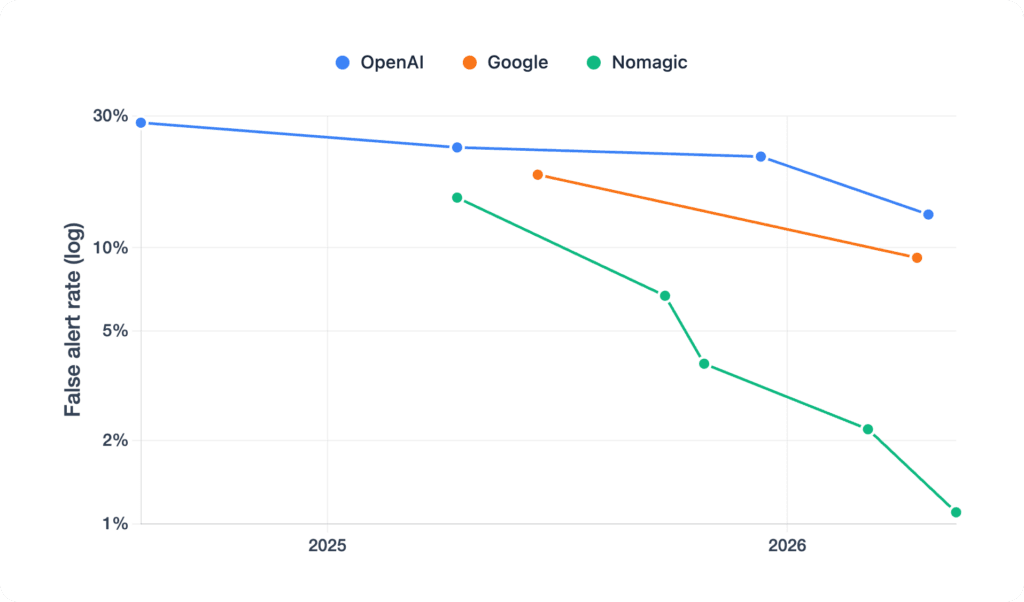
These challenges make general-purpose models fall apart. In our benchmarks, state-of-the-art generalist vision-language models showed a much higher false alert rate under these conditions – high enough that the cost of handling false alerts overwhelms the value of automating the check in the first place.
The gap is not a matter of polish. On the same orders, Spot holds a false alert rate under 1% – the line where autonomous verification starts to pay for itself – while the strongest generalist VLMs we tested sit above 8%, roughly eight times higher. The generalist models are capable of recognizing what’s in a clean image; what they can’t do is separate the tightly packed, occluded instances that are the reality of the warehouse floor. It proves that mastering that one task end to end, in production, is what moves a system from “impressive in a demo” to “deployable on the line.
How Spot closed the gap
The result came out of roughly a year of focused work, built on three reinforcing pillars. Each addressed a different bottleneck, and each moved the false alert rate down a measurable step while holding detection high.
1. A data engine targeted at hard real-world orders. Accuracy at the tail comes from learning from your hardest cases quickly, not from more average data. Nomagic’s data engine maintains a tight, high-quality feedback loop with live production deployments, so the occluded, split, and near-duplicate orders that fool the model get surfaced, labeled, and fed back rather than averaged away. This data-driven loop, focused on the hard tail, has a strong impact on the false alert rate and allows us to significantly decrease it.
2. A verification architecture built for occlusion. General detectors implicitly assume the thing they’re counting is visible. In a packed pharma box it usually isn’t. We reworked the core model to reason explicitly about the occlusion regimes above – partial views, split instances, side-only stacks – and to make fine-grained variant distinctions from whatever cues remain visible, instead of treating the hard cases as noise. Handling these as first-class cases, combined with the data engine described in the previous point, is another important part of decreasing false alert rates.
3. Order metadata as a prior – without the failure mode it usually introduces. Every order ships with metadata describing what should be in the box, which is a strong prior if you use it correctly. Here we found something worth flagging: when we conditioned state-of-the-art VLMs on the same metadata, their detected error rate collapsed. The prior anchored them toward confirming the expected contents – a confirmation-bias failure where the model stops looking for discrepancies once it’s told the expected answer.
That third point is the technically interesting one. The last stretch of reliability wasn’t won with a bigger model or more compute – it came from understanding why the obvious use of a prior quietly degrades detection, and engineering around that specific failure. In short: the prior should resolve ambiguity, it never overrides evidence.
Why the operating point matters in production
In a demo, a few percentage points of error look like polish left to do. In production they have a direct impact on the cost structure. Detected-error misses are the failures you’re trying to prevent – a wrong item reaching a patient; false alerts are a recurring labor cost that scales with throughput. An autonomous verification step is only worth running if it’s reliable enough to be trusted without a human re-checking it, which means living at the top of the recall curve I the bottom of the false-alert curve at the same time.
Reaching that point in pharmaceutical fulfillment came down to owning the full stack of the problem: the data loop that surfaces hard cases, the architecture that handles occlusion and the careful treatment of priors that helps rather than blinds the model. That’s the work behind Spot: and the reason it holds up on the orders that actually break other systems.
What does this mean for the future of Physical AI?
The common assumption – we can call it the generality-first bet – is that the main challenge for deploying physical AI is the creation of generalist models – able to do many things well and eventually able handle tasks like this out of the box. Our experience points the other way. The strongest generalist models we tested were genuinely capable, yet they sat an order of magnitude short of a deployable false alert rate. Breadth is an important component but it does not suffice for pure autonomy and the start of ROI in a real warehouse environment.
What closed that gap is the opposite bet: mastery-first. Going deep on one task, in real deployments, until the system handles cases that only appear in production. Mastery of that kind doesn’t rely on any general pretraining corpus. The cases that define it exist only in live operations;it’s earned in a loop. Live deployments generate the hard long-tail – building the foundation of model improvement. Each turn compounds. This is the deployment flywheel and it’s what carried Spot from generalist-level performance to detection above 98% at sub-1% false alerts.
This is our bet for the path for physical AI more broadly. Autonomy in the physical world is gated not by average-case competence but by the long tail, and the long tail only reveals itself in production. Systems embedded in real operations and built to learn from them will pull ahead – enabling the expansion from narrow to increasingly broader mastery. It’s also why this is less a path for a new lab than for a company already embedded in real deployments with satisfied customers. Spot is one example where we’ve now watched that happen. It won’t be the last.
Autor: Markus Wulfmeier, Główny Naukowiec W dążeniu do stworzenia uniwersalnej, fizycznej sztucznej inteligencji, nasza dziedzina wciąż patrzy w przyszłość: projektując ogromne symulacje, zbierając dane z internetu, gromadząc coraz większe zbiory danych teleoperacyjnych. A jednak…
Autor: Filip Grządkowski, Wiceprezes ds. Inżynierii W wyścigu o automatyzację świata fizycznego nie wszystkie inteligencje są sobie równe. Od lat motorem napędowym robotyki są przełomy w laboratoriach sztucznej inteligencji:…
Niezawodność, a nie sprzęt czy modele sztucznej inteligencji, staje się prawdziwą przewagą konkurencyjną w dziedzinie fizycznej sztucznej inteligencji. W miarę jak roboty przechodzą z wersji demonstracyjnych do zastosowań w świecie rzeczywistym, tylko systemy osiągające niezawodność na poziomie 99,9%…