Every messy, improbable, once-in-a-million pick captured, labelled, and turned into intelligence.
A demo warehouse is tidy. A real one is not. Items arrive stuck together, wrapped in reflective film, crushed out of shape, or resting label-down at the bottom of a near-empty tote. This is the long tail of reality that the near-infinite variety of situations that look trivial to a human and impossible to conventional automation.
Most robotics never escapes it. Impressive on the demo floor, they stall the moment reality stops cooperating that is what the industry politely calls pilot purgatory. The gap between a prototype and a product isn't the easy 95% of picks. It's how you handle the rest.
The Library of Chaos is how we handle the rest.
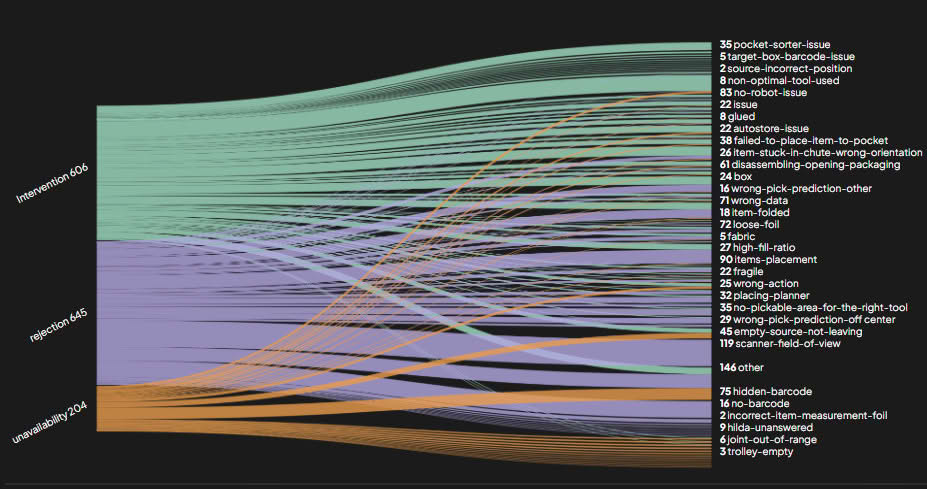
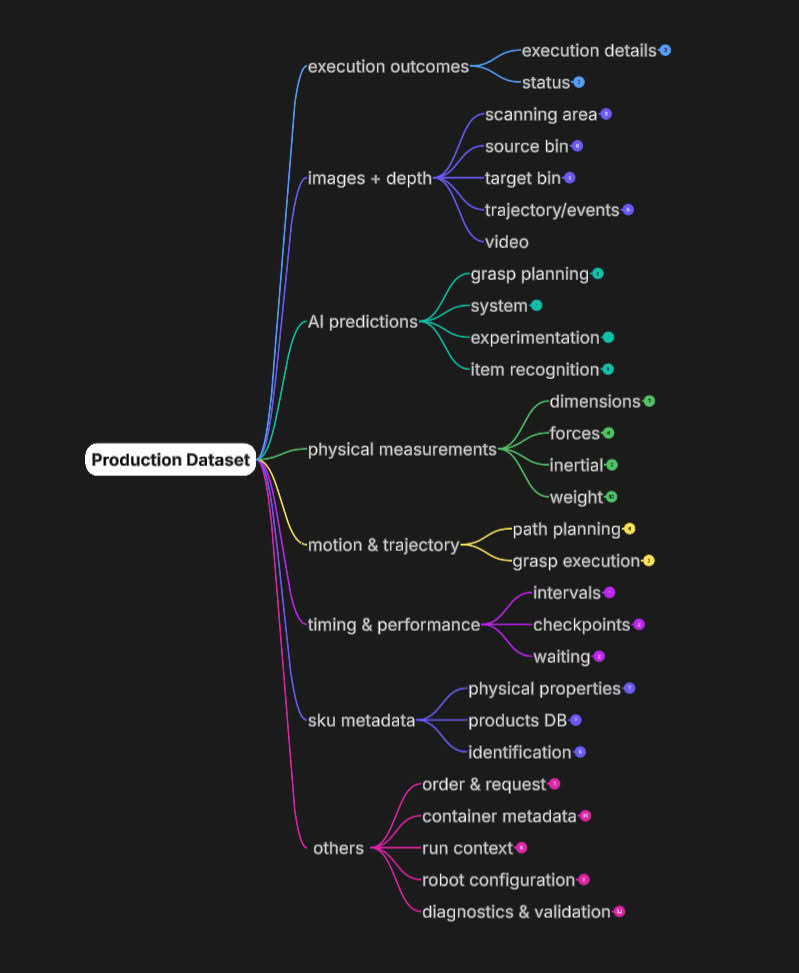
The Library of Chaos is our continuously growing dataset of real-world edge cases: millions of SKU interactions gathered from live, 24/7 warehouse operations rather than staged experiments. Every unusual grasp, every packaging failure, every awkward orientation and misplaced label becomes a recorded, structured example our AI can learn from.
Because it's built from production data, it captures the situations that actually occur at scale and not the ones we imagined in a lab.
Edge cases aren't noise to be filtered out. They're the most valuable training signal we have. Each one teaches our Physical AI something new about how the physical world behaves: how a two-piece box shifts when its lid isn't sealed, how a polybag deforms mid-lift, how light plays off a shrink-wrapped surface.
Feeding this experience into our AI Brain and Visual-Language-Action models turns rare, hard problems into learned, repeatable competence. Situations that once forced a robot to stop and call for help become routine — the reason we've been able to roughly halve robot-caused interventions in live operations and sustain 95%+ picking coverage across diverse inventories.
The Library of Chaos is a flywheel. Every robot we deploy encounters new edge cases; every edge case enriches the dataset; every enrichment makes every robot in the fleet more capable. The messier the world gets, the smarter our systems become.
That's what separates automation that survives a demo from automation you can trust to run your warehouse.