From shoebox to trench coat: the full fashion assortment, robot-ready.
By Przemysław Walczyk, Principal Engineer
Long garments, from coats and maxi dresses to anything on a hanger, have traditionally caused problems in warehouse automation. Conventional systems either couldn’t pick them at all, or ran into issues while handling them: the items dragged, snagged on equipment and couldn’t be placed properly. Nomagic’s new long-item automation changes that. It combines AI that recognises these items and works out how to pick and manoeuvre them with a newly designed gripper built for length. It’s already live in production at Zalando.
Fashion, one hard item at a time
Polybagged apparel makes up a large share of fashion fulfilment centre volume. It has never been easy to automate: the packaging is reflective, the contents shift, and no two items deform the same way. Nomagic’s robots have handled these challenges reliably across tens of millions of picks in live operations and multiple customer sites.
Yet full warehouse automation in fashion has been held back by a small group of non-standard formats, including shoeboxes, long garments and garments on hangers.
We have been closing that list one item type at a time. First came shoeboxes: our Shoebox Picker made them a routine pick.
The next gap was length. In theory, a robot can pick coats, maxi dresses and garments on hangers the standard way. In practice, they trigger interventions and other problems far more often than regular items. Our new long-item automation closes that gap.
The challenge: the trouble with long items
A robot station is built around typical item sizes. A floor-length coat is not typical. Picked with the standard polybag tool and flow, long items caused problems at almost every step:
Long garments get caught on the robot station’s frame as the robot moves them.
Long items are hard to set down accurately in the small space where they get scanned.
Barcodes are often hidden in folds, so they’re difficult to scan.
Large garments are floppy and change shape when the robot grabs them, making them hard to hold securely.
In a pocket sorter, a loose hanger hook can snag other pockets and jam the system, causing costly outages.
Each of these meant a stop and a person stepping in. The alternative was a decision not to pick the item at all. Skipping it caused problems of its own: long items often cover other items in the bin, so those couldn’t be picked either.
The solution: AI meets a new gripper
This innovation combines AI with new hardware: AI that recognises long items and works out how to pick and manoeuvre them, a newly designed gripper the robot picks up on its own, and a new motion path built for length.
AI detection and planning.Grip AI, Nomagic’s frontier AI model for robotic picking, spots a too-long item while it is still in the source bin and defines how to pick it and move it through the station.
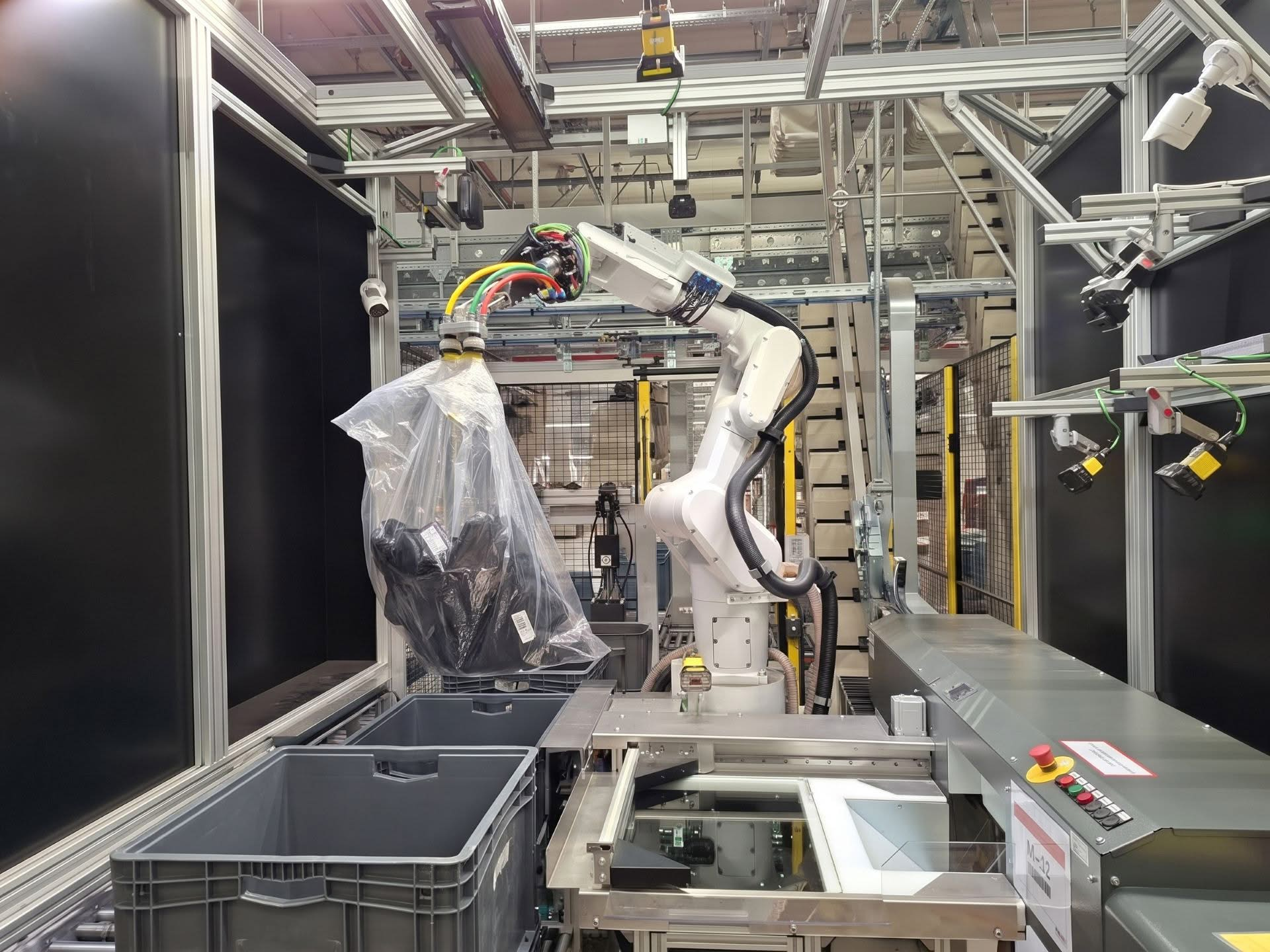
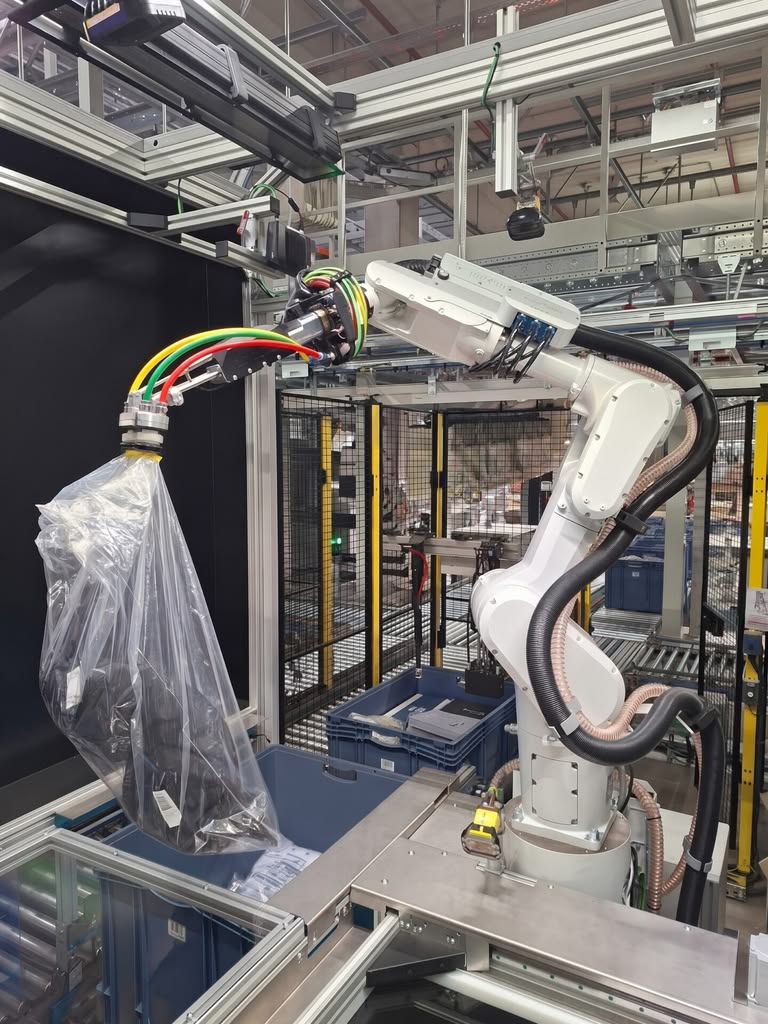
A new gripper built for length. A dedicated long-item gripper with two suction cups and a swivelling suction segment, designed to lift long garments high and hold them securely. The robot switches to it automatically through its tool changer, with no operator involved.
A trajectory built for length. For every long item, the robot chooses the optimal trajectory: one that keeps the item clear of every station element.
Inside the new gripper
Two suction cups instead of one on the standard polybag tool, for a firmer hold on heavy, long garments.
A smart swivelling joint. It lets the robot lift long items much higher than a standard tool can, so they pass safely over the station without catching on anything.
Exception handling workflow
When a long item appears in a bin, the system works through four steps:
Detection. The Grip AI model analyses the bin’s contents and recognises that it contains a long item.
Planning. The model decides the best way to pick up that specific item, based on its size, shape and position in the bin.
Picking. The robot automatically switches to a tool suited for long items and picks the garment.
Placing. The garment goes into a special target container for oversized items. This clears the way for the robot to pick the remaining items in the bin as usual.
As a result, long items are handled automatically, the rest of the bin keeps moving, and no manual intervention is needed.
Results: fewer stops, fewer rejections, live in production
This isn’t a lab prototype. The long-item automation runs today on 13 production robots across 4 client sites and handles around 7,500 long items every week, with no operator stepping in. Handling long items enabled us to perform 15% more robotic picks from the same number of bins.
13 robots, 4 sites
Already in production
Under 2 months
From business need to full production deployment
83%
Fewer interventions caused by long items
Speed: from business need to live solution in 8 weeks
We went from business need to a solution fully deployed in production at scale in under two months.
That speed is by design. Nomagic’s platform is built to adapt: new AI capabilities, new tools and new motion paths can be rolled out to robots already working in the field. When the market shifts or a client’s assortment brings a new challenge, we respond in weeks, not years.
What’s next: a fully automatable fashion assortment
The hard part is already done. The robot can recognise a long item, switch to the right tool by itself and move a floor-length garment through the cell without touching a thing. Those are the building blocks for handling long items in whatever flow a site needs.
Put it together with the Shoebox Picker, accessories handling and the standard polybag flow, and the picture is clear: the formats that once kept fashion out of reach for robots are falling one by one. Fashion is becoming fully automatable.
In summary
Long garments like coats and maxi dresses are a practical manipulation problem for warehouse robots: they’re floppy, catch on equipment, and often block other items in the bin. Nomagic solved it with a self-learning AI system that recognises long items, plans each pick and guides them safely through the station, paired with a highly efficient dedicated gripper that lifts and holds these garments securely.
Deployed in under two months, the solution now runs on 13 robots across 4 customer sites, significantly decreasing interventions. This is Physical AI built for high throughput and high reliability.
Have items your automation still can’t handle? Let’s talk.
By Szymon Trochimiak, Senior ML Research Engineer For physical AI, simulation and real-world are not competing but complementary data sources. Sometimes an item opens while the robot is carrying it.…
By Michał Grzejdziak-Zdziarski, Senior Machine Learning Manager; Markus Wulfmeier, Chief Scientist Making sure every order that ships to a customer is correct sounds like a solved problem until you look…
By Markus Wulfmeier, Chief Scientist In our pursuit of general-purpose physical AI, our field keeps looking to the horizon: designing massive simulations, scraping internet video, curating ever-larger teleoperation datasets. Yet…